The car dealership is the youngest segment in this series — and the only one where the key does not belong to a door but to an object that can drive away by itself. That changes more than you might think. In an alarm service the client key hangs in the same place for years; in property management often for decades. In a dealership the key arrives with the vehicle, passes through reception, workshop, valeting and sales within a few days — and leaves the building with the vehicle again.
Five car dealerships manage their vehicle keys with Log+Key today, from the single-brand business with a few dozen keys to the group with more than a thousand, plus a pilot project at an enterprise dealership. They have taught us six things that apply in no other sector quite like this.
Lesson 1: search time is the only metric that counts
In home care it was about documentation, in property management about evidence. In the dealership it is about something simpler: time. The customer is standing at the desk, the vehicle is ready, the key is not — it is somewhere between the workshop and valeting, and the service advisor is phoning round the building while the customer watches.
What sets the dealership apart from the other sectors: here four or five departments use the same keys, and traditionally each keeps its own list. Sales, service, valeting, collection and delivery. The gap does not arise from carelessness but at the seams between those lists. The first dealership group to introduce Log+Key described the situation before like this: "Documentation? Laborious, error-prone and often incomplete." And after: "At last every key movement is recorded digitally." We published the full case study at the time.
Lesson 2: the key belongs to the vehicle — not to the hook
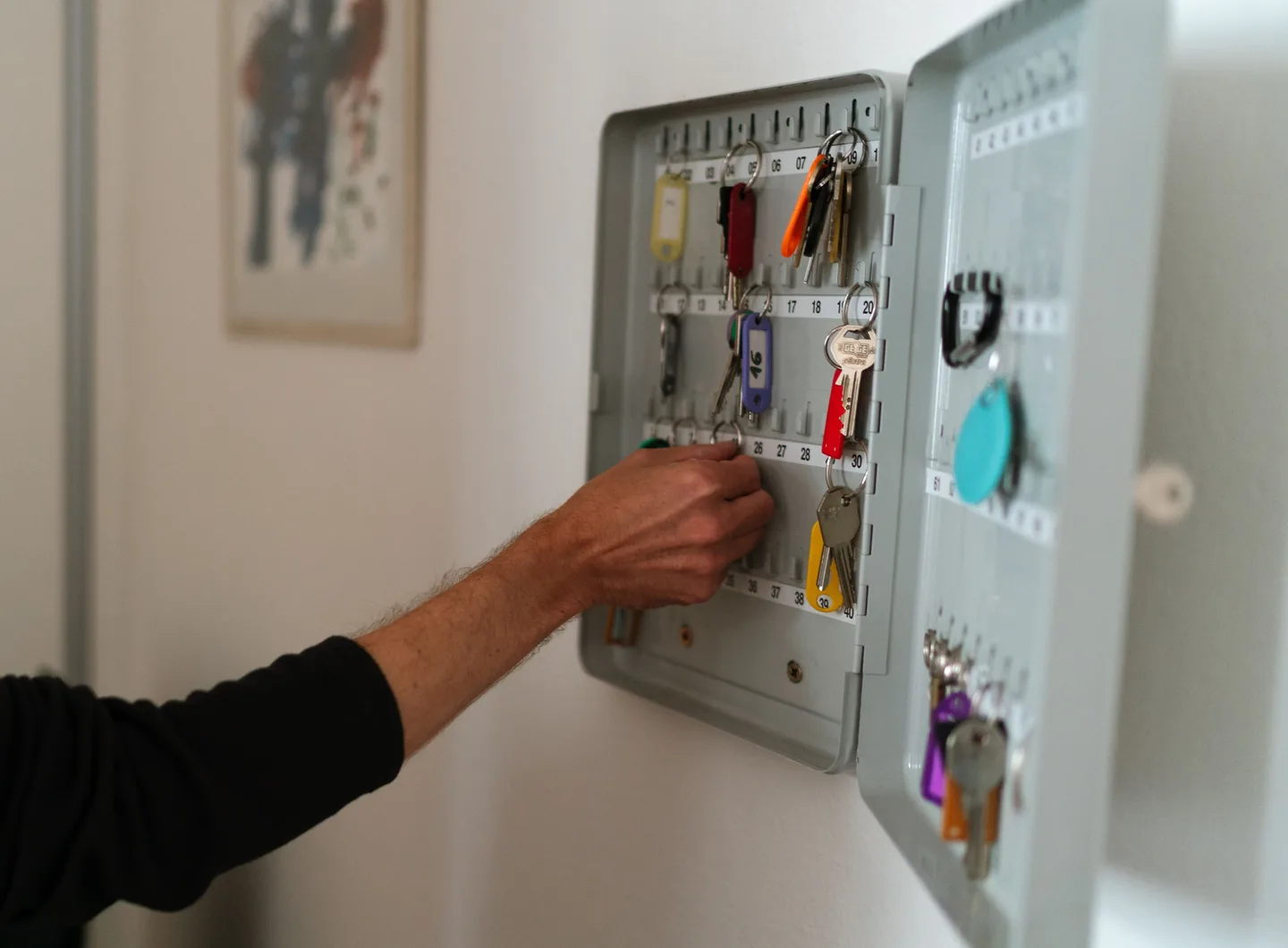
The board full of unlabelled fobs is especially treacherous in a dealership, because the stock changes constantly. Flat key 12 stays flat key 12. Hook 12 in a dealership holds a Golf this week and a Tiguan the next. A number on the hook therefore says nothing; what counts is the link to the vehicle.
The dealerships taught us which master data has to hang on the key: chassis number, registration plate, model, parking space and, where relevant, the customer. And that a vehicle usually has two keys — two tags, one vehicle record, each scannable on its own. A pilot project with an enterprise dealership additionally produced the printing of key cards: registration plate, model, parking space and customer salutation on a card on the ring, so that even the colleague who has never opened the system knows what he is holding. As with everything a customer commissions from us, the function is then available to everyone.
Lesson 3: a return is only complete once the parking space is in it
We did not find this lesson ourselves — a customer sent it to us. In a dealership the key is back, but the vehicle is standing somewhere on a lot with two hundred spaces. Having the key in the system helps little if the car then has to be searched for.
So the return was extended: when scanning back in, the exact parking space is documented too. A small function, born from an improvement suggestion, that has changed more in daily work than many a big release. The dealership that prompted it wrote to us afterwards that the extension "saves us several hours of working time every day" — here is how it came about. For us it confirmed a principle from part 1 of this series: the best functions are not born at the whiteboard, but at the service desk.
Lesson 4: the test drive is a handover to a stranger
In service the key stays in the building. In sales it leaves — with a person you met for the first time twenty minutes ago. The test drive is the only situation in this series in which a key goes, by design, to someone who is neither an employee nor a customer, with a remote key on the ring whose replacement quickly runs to three figures.
What has proven itself resembles the contractor handover in property management: pick the recipient or type in a name, set a return time, signature on the tablet — in seconds, because the prospect should not have to wait. The difference is the tempo: on a Saturday in October a dozen vehicles go out on test drives from one site, and by evening every key has to be back in its place. The live overview with due returns is therefore not a nice-to-have in sales, but the list that gets checked before locking up.
Lesson 5: the DMS stays the leading system
Every dealership runs a dealer management system, and the vehicle data already lives there: chassis number, registration plate, model, customer. A key management tool in which the same data is maintained a second time by hand is exactly the duplicate work that was supposed to go away — a lesson we know from alarm services, where the dispatch software UMO is the leading system.
In the dealership the leading system is called CROSS, AUTOHAUSEN or something else. What an integration with it can look like — taking vehicle data from the DMS, reporting key status back — is something we are currently trialling together with an enterprise dealership. It is a pilot, not a product; whether and when it becomes a standard interface also depends on the DMS vendors, and we promise nothing here that is not yet running. The direction, though, is the same as in every sector of this series: digitalising key processes is above all integration work. Independently of the DMS there is the open API, through which vehicle and key data can be connected to existing systems.
Lesson 6: enterprise dealerships think in sites — and in years
The dealership taught us a lesson about ourselves. Small businesses decide fast — the site manager sees the problem at the desk and solves it. Enterprise dealerships decide differently: there are head-office requirements, several sites with the same processes, IT approvals, data protection reviews. A pilot there takes quarters, not weeks.
We have learned to see that not as a hurdle but as a test you pass once. What works in a pilot at one site can be carried over to the others — site management and per-site user permissions are built into Log+Key for exactly that. And the functions an enterprise dealership commissions because its processes need them make the product better for the single-brand business with forty keys that could never have paid for them. The same model as with the alarm service associations, just with a longer breath.
What this means for your dealership
If you run a dealership or a workshop and your vehicle keys still hang on a board with paper notes, the six lessons make a usable self-check: how long does it take to find a key in peak season? Do you know which key belongs to which chassis number — and where the vehicle is parked? Is a test drive documented in seconds, with a return time? And are your staff maintaining vehicle data in two systems?
Everything else can be found on our page about key management for car dealerships and fleet management — and for issuing keys at reception or in the workshop, it is worth a look at the terminal. If you would rather talk through your own routines directly: we offer a free initial consultation — we know the processes, the decision is yours.
Next in the series: facility management and caretaker services — one team, forty buildings, and keys that are regularly lent to external parties. Managing property alongside your fleet? Then it is worth looking back at part 3 — and at part 1, where the integration lesson comes from.