Assisted-living alarm services are the sector Log+Key grew out of: in 2020, in a room at the Johanniter, in front of a handwritten key book and several thousand client keys. Today, not quite three years after version 1.0 launched, 21 alarm service organisations manage their keys with Log+Key — district and regional branches of DRK, Johanniter and Malteser, holding anywhere from a few hundred to several thousand client keys.
This article opens a series. Sector by sector, we look at what digitalising key processes actually means in that field — not the glossy version, but what we have genuinely learned during rollouts, in support requests and from feature wishes. We start with assisted-living alarm services, our oldest and largest segment. Six lessons.
Lesson 1: the process breaks at three in the morning — not in the trial run
During the day almost any key process works. Someone who knows the ropes is there, the key book is in its place, a colleague remembers. The truth about a key process in an alarm service shows itself when an alert comes in at night and someone behind a locked front door needs help.
In that moment a single question counts: is the flat key there — and if not, who has it? Every minute spent searching is a minute the client spends waiting on the floor of their home. That is why we have judged every process and every feature by the three-in-the-morning test ever since: does it work when the experienced colleague is not there, time is short and nobody wants to think? Paper and Excel practically never pass it.
Lesson 2: keys rarely change hands — they get left hanging
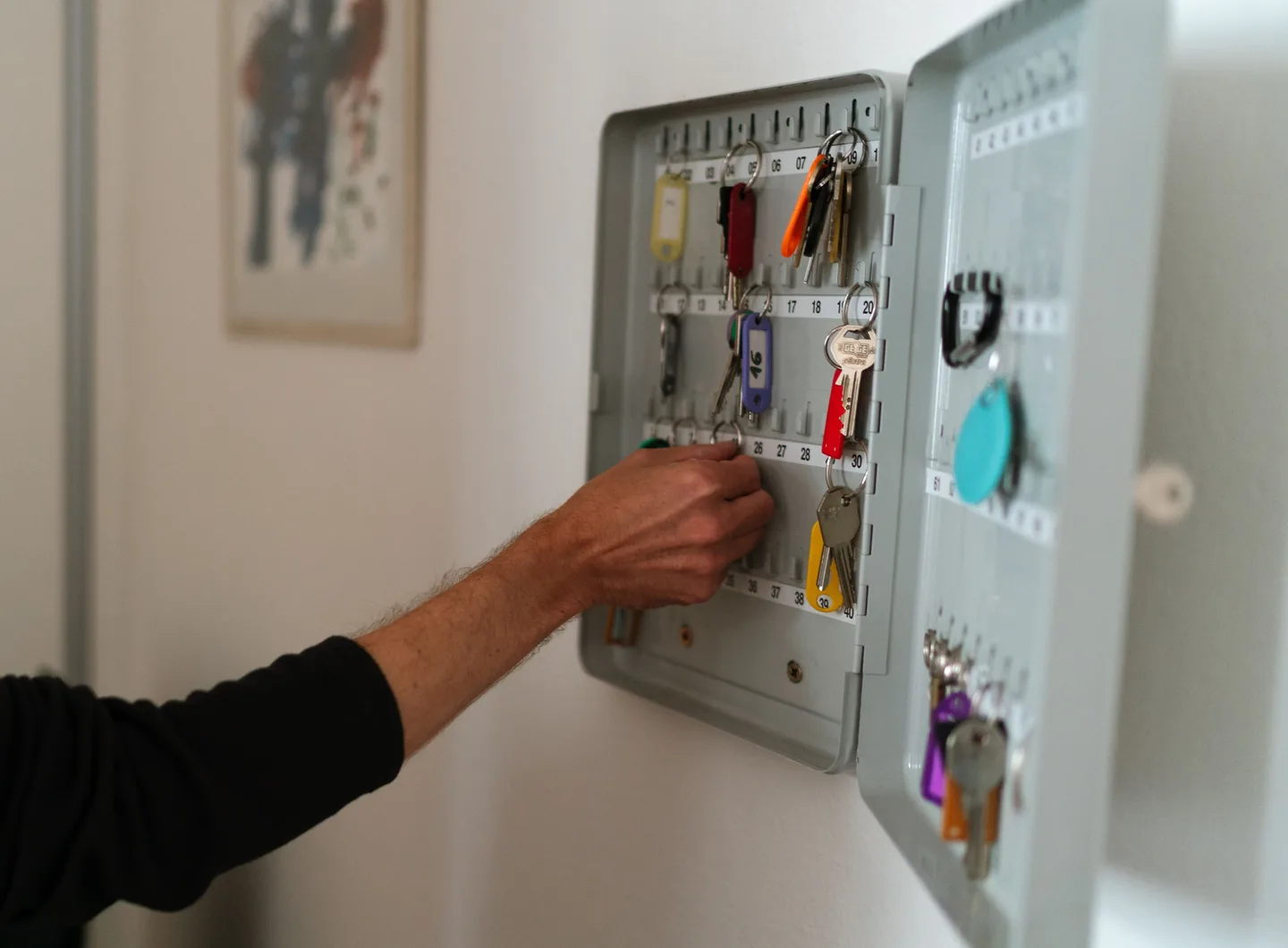
Unlike home care, where keys do pass from one colleague to the next over the course of a day, a key in an alarm service is rarely handed on directly. It is taken out, travels to the call-out — and is then meant to go back to its place. That is exactly where the typical gap appears, in two variants. The key ends up in a jacket pocket after the call-out instead of on the key board. Or it is back in its place, but the entry is missing because there simply was no time during the call-out. Either way the documentation no longer matches reality — and that only comes to light the next time the key is needed.
The fix is less a matter of appealing for discipline than a question of system design: open checkouts have to be visible by themselves. If the team can see at the end of a shift which keys have not been returned, the reach into the jacket pocket happens that same evening — not at the next alert for that very flat.
Lesson 3: documentation only happens when it happens in passing
The most uncomfortable lesson, and we say it very plainly to prospects too: staff on call-out duty do not document for the sake of statistics. If the scan takes longer than grabbing the key, at some point people stop scanning — under call-out pressure first of all.
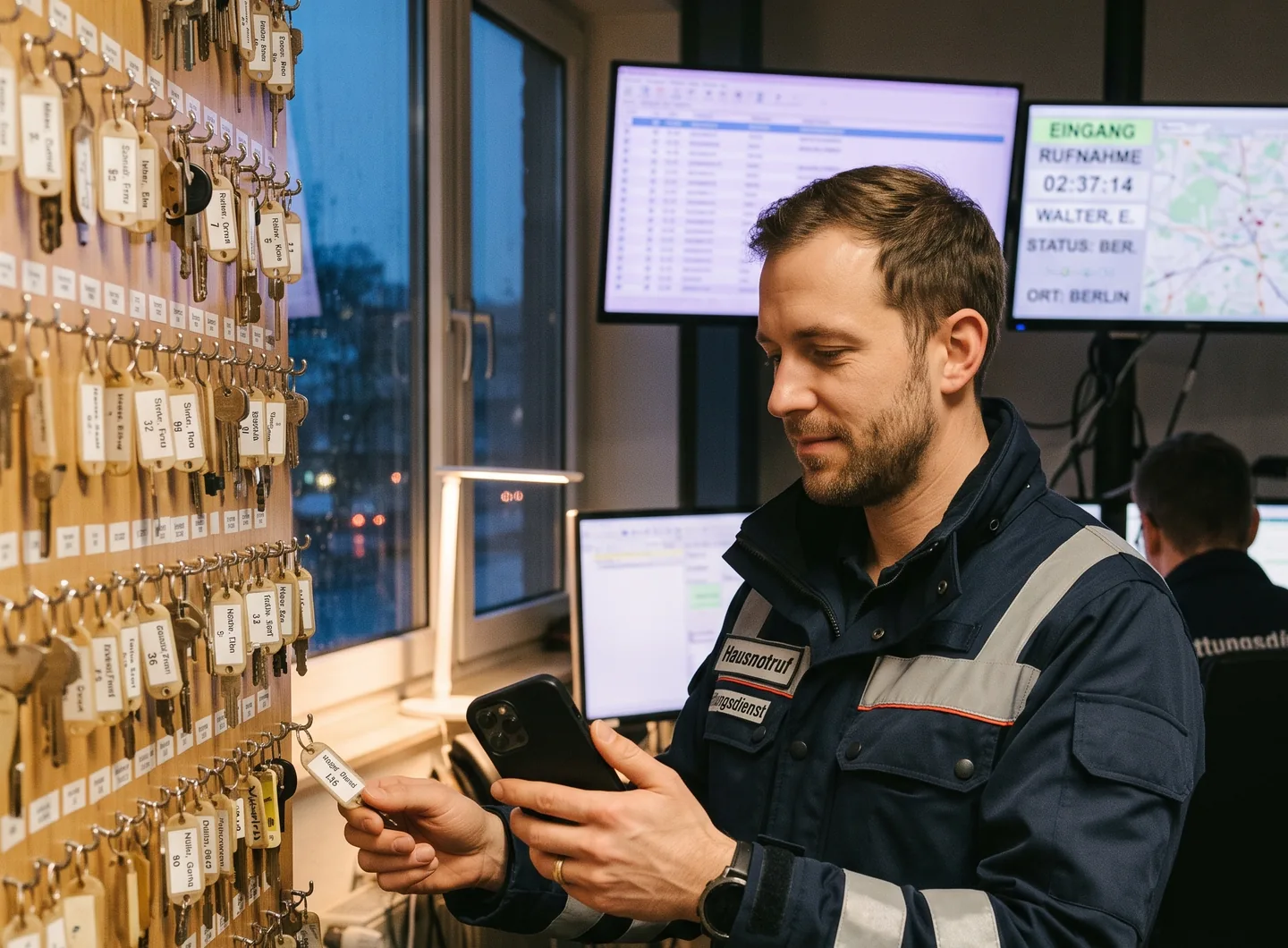
That is why checking out a key in Log+Key is an NFC scan: hold the keyring to a smartphone or to the terminal, done. And that is also why this weak spot still interests us — for situations in which even the scan is forgotten, we are currently experimenting with active radio technologies that record checkouts automatically. As soon as we have solid results, we will write them up.
Lesson 4: dispatch software and key status belong in one system
Alarm service organisations work with dispatch software — in most associations that is UMO. Dispatchers dispatch there, not in a second system. A key management tool running alongside it creates exactly the duplicate record-keeping that was supposed to be abolished.
Our customers demanded the consequence; we did not invent it: Log+Key provides the UMO integration, so that key status is visible directly in dispatch. It is one of the most-used interfaces in the system — and a good illustration that digitalisation in this sector is above all integration work.
Lesson 5: hardware follows the process — not the other way round
We deliberately built Log+Key as a software solution: a smartphone is enough, no safe to install, no locksmiths. But alarm services taught us where hardware does have its place — namely where the process calls for it. The wall terminal at the key store for fast bulk checkouts. Logging in with an NFC tag instead of a PIN when things have to move quickly at the response vehicle. Photo documentation of the keyring at handover.
Almost all of these functions grew out of concrete requirements from individual associations — commissioned by one, then available to all. This model (commissioned development with shared benefit) has proven a surprisingly effective accelerator of digitalisation in the association world.
Lesson 6: associations learn from each other — faster than any sales team
Perhaps the nicest observation: no alarm service association digitalises alone. One regional branch introduces a system, talks about it at the next association meeting, and two neighbouring branches come to take a look. Functions commissioned by one district branch make the product better for everyone else — and lower the cost for latecomers.
For organisations still working with a key book or Excel, that means something concrete: you do not have to invent the route yourself. The routines that work at more than 20 associations are proven and transferable.
What this means for your organisation
If you carry responsibility for an alarm service and your key processes still live on paper or in Excel, the six lessons make a usable checklist:
- Does your process survive the three-in-the-morning test?
- Do open checkouts surface by themselves at the end of a shift?
- Does documenting take seconds or minutes?
- Does your key management talk to your dispatch system?
Everything else — including the experiences of Malteser and Johanniter — can be found on our page about key management for assisted-living alarm services. If you would rather talk through your own routines directly: we offer a free initial consultation — including when no Log+Key comes of it in the end. We know the processes; the decision is yours.
Next in the series: home care — rounds, staff turnover, and the question of why quite different things go wrong there than in alarm services. Running both under one roof? Then it is worth a look at key management for home care.