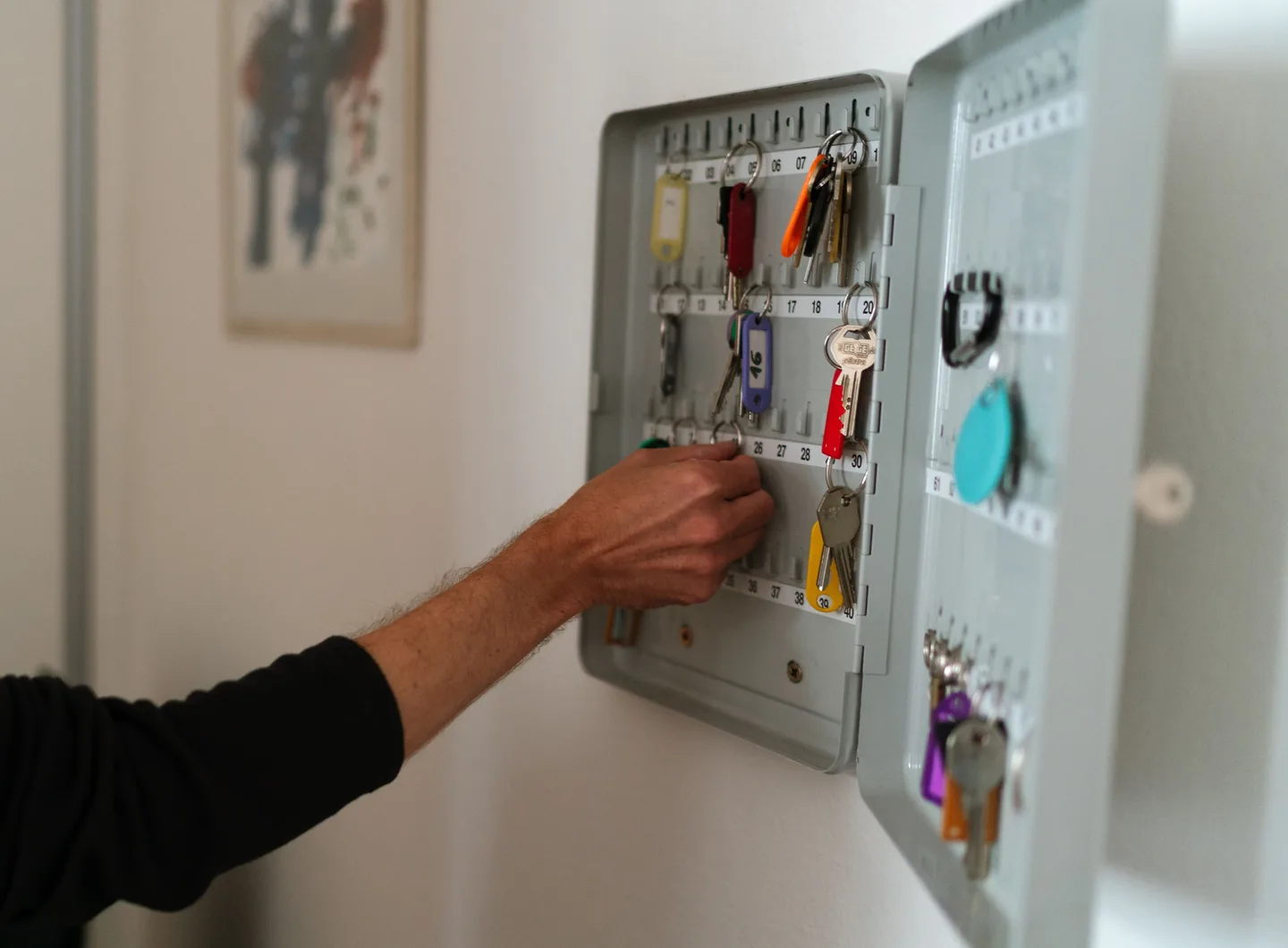
In the previous parts of this series the keys always belonged to the business itself or to its clients. In building services it is different: the keys belong to the customer. A cleaning company, a caretaker service, a restoration firm — they all hold keys to properties that are not theirs, on behalf of property managers and owners who will at some point ask where those keys have been.
Ten building service providers manage their keys with Log+Key today — cleaning companies, caretaker services, restoration firms, facility managers and technical service businesses, from just under a hundred keys to several hundred, with one outlier far above. It is the sector with the most properties per head: one employee looks after eight buildings, her keyring is on the road all day, and exactly what hangs on it, only she knows. Six lessons, as always without the gloss.
Lesson 1: the key store is the bottleneck — out in the morning, back in the evening
In facility management every key route converges on one point: the store. Between six and seven in the morning twenty people collect their keys for the day; in the afternoon they bring them back. Anyone who wants to document that moment with a key book and a ballpoint pen has a queue in front of the store and a list nobody reads.
That has shaped our terminal more than any other sector. It is deliberately not an administration interface but a device for mass checkout: tap your name in the list, PIN, scan the keys — everything scanned is checked out; whoever scans the same keys in the evening returns them. No menu, no form. What the alarm services taught us about three in the morning, building services taught us about the rush hour at the store: the process has to be quicker than walking past.
Lesson 2: proof is not paperwork — it is the bid for the next contract
In property management the history serves your own protection. In building services it is something else: an argument towards the customer. Owners and property companies entrust a service provider with their locking systems, and increasingly they ask already in the tender how he handles them. A paper key book convinces nobody there any more; for larger tenders a digital key management system is now frequently a requirement, not a bonus.
That is why our FM customers taught us early on that documentation has to be exportable. Not just "we could look it up", but: a report per property, every checkout and return with timestamp and name, with signature on request — as evidence for the client, as an attachment in the audit, as a page in the proposal. Stocktaking belongs with it: an inventory of hundreds of keys across dozens of properties cannot be counted, but it can be scanned. Site by site, with a photo for visual inspection, and at the end a closed state that no longer changes.
Lesson 3: staff turnover here is seasonal, not exceptional
Home care taught us that every staff departure is a key return. Building services sharpened the lesson: here there are seasonal workers for winter service, temps for the summer deep clean, subcontractors for the maintenance peak — and holiday cover that takes over the keyring with a handshake in the yard. The changeover is not the exception to the process; it is the process.
What has proven itself: the overview of open checkouts per person is the most-used view in building services altogether. On departure it shows within a second which keys are still missing. For holiday cover, the ring is scanned in from one person and out to the other — on a smartphone, in the van, without a detour via the store. Anyone who does not document this discovers in March, when winter service winds down, that three master keys are with people who have not worked for the company since February.
Lesson 4: externals lend to externals
A building service provider is already a contractor — and still passes keys on: to the subcontractor for lift maintenance, to the electrician, to the client's own technician. The key thereby moves two steps away from its owner, and every step needs a record, otherwise the service provider ends up answering for what a third party did with the key.
A technical service provider whose technicians regularly hand keys on to external parties demanded a function from us here that we initially took for a niche need: the receipt. On checkout and return a PDF is created — who, what, when, with signature — that goes straight to the recipient or to the client. Today the receipt is in use in every sector, from the contractor in property management to the test drive at the dealership. One of the functions a customer commissioned for themselves that was then available to everyone.
Lesson 5: tools are just one more object
The caretaker services showed us a limit in our own thinking. We had built a key management system. They asked: and the ladder? The cordless drill? The measuring device worth eight hundred euros that is lying in the wrong van? What applies to the key — who has it, since when, where is it — applies to every piece of equipment a team carries back and forth between properties.
So in Log+Key the key is merely the most common case. Every object gets an NFC tag — as a fob, a sticker or a cable tie, depending on what it has to attach to — and appears in the same overview: the toolbox next to the master key, the snow shovel next to the flat key. The scan is the same, the history is the same. That this grew into a dedicated inventory management was not something we planned. The caretakers commissioned it from us.
Lesson 6: two operating modes, one principle
When writing our sector pages we split building services into two pages, and the split comes directly from lessons 1 and 3. There is the business with a central store, where everything goes out in the morning and comes back in the evening — that is where the terminal stands, and keys move not between people but between store and property. And there is the team that is on the road all day and never meets at the store — there the smartphone is the tool, and the handover happens in the van or at the property door.
Both work on the same principle: tag on the ring, scan on every movement, history without a list. But they need different devices, and anyone who sells the terminal to a team that is never at the store has understood nothing. Hence two pages: key management for building and facility management and key management for caretaker services. The lesson behind it holds for the whole series: the process decides the hardware, not the other way round.
What this means for your business
If you run a cleaning, caretaker or facility business and your keys still move by shout and scrap of paper, the six lessons make a usable self-check: how long does the morning issue at the store take? Could you send a client a report on the handling of their keys today? Do you know which keys a seasonal worker has to bring back on their last working day? And who has the measuring device?
Everything else can be found on our pages about key management for building and facility management and for caretaker services — for the rush hour at the store, it is worth a look at the terminal. If you would rather talk through your own routines directly: we offer a free initial consultation — we know the processes, the decision is yours.
Next in the series: public institutions — municipalities and administrations where keys are issued across departments, documentation duties are non-negotiable, and the question of data protection comes before the question of price. Looking after properties for a property manager? Then it is worth looking back at part 3 — and at part 2, where the turnover lesson comes from.