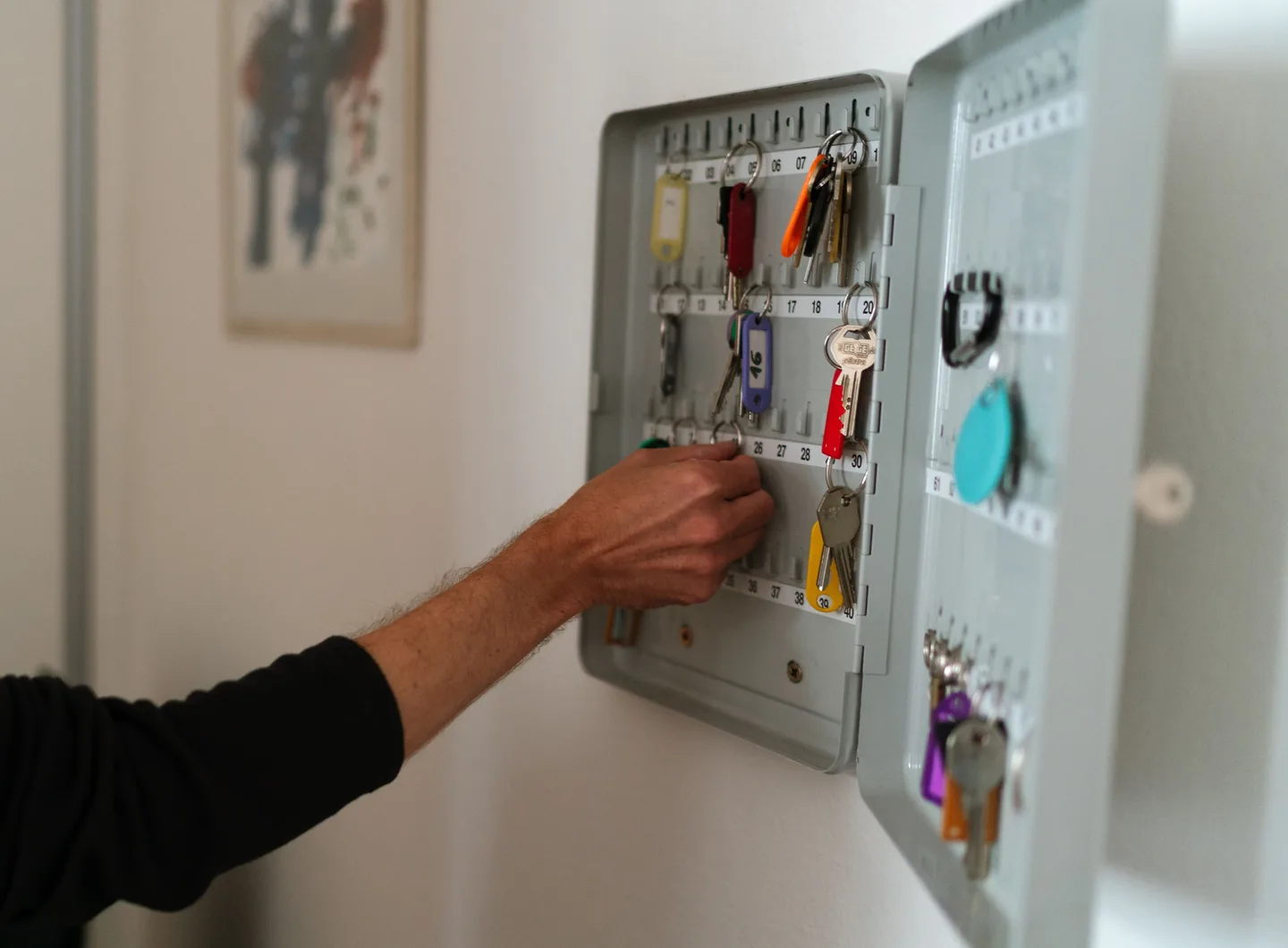
Assisted-living alarm services and home care — the first two parts of this series — have one thing in common: the keys belong to clients, and the team carrying them is your own. In property management, both are different. The keys belong to buildings you manage on behalf of owners. And half the people who end up holding them are not from your own office at all: contractors, cleaners, tenants moving in, tenants moving out, the caretaker, the colleague from the neighbouring office.
Six property management firms manage their keys with Log+Key today — typically businesses with two to ten staff and roughly 100 to 300 keys. Not a large segment, but an instructive one, because here almost every key transaction is a handover to somebody else. Six lessons, as always without the gloss.
Lesson 1: the loss is not what is expensive — the follow-up question is
Lost keys are remarkably rare in property management. What happens every day is the follow-up question: "Who has the key to flat 12?" A contractor is standing outside the building, the case handler responsible for the property is in a meeting, the key is neither on the board nor with the caretaker — and the office turns into a switchboard.
A firm that makes a few of these calls a week quickly loses an hour or two — spread across several people who all interrupt their actual work for it. For almost all of our property management customers, this was the trigger to tackle the topic. Not a spectacular loss, but the sum of the interruptions. Ilker Simons of REAQ Immobilien describes the effect like this: "We always have an overview of which key is with which member of staff. Since introducing Log+Key, we spend noticeably less time tracking down where a key currently is."
Lesson 2: most recipients have no account — and do not need one
In home care, a colleague documents her own checkout. In property management, you usually hand the key to someone who does not exist in the system at all: the plumber, the painting firm, the cleaner, the new tenant. Anyone who had to create a user account for each of these recipients would have lost the process before it began.
The solution that has established itself is simple: the member of staff scans the key out, picks the recipient from the contact list or types in a name, sets a return date — done. If the record matters, the contractor signs once on the tablet and receives the receipt as a PDF. The live overview then shows every issued key with its due date. The contractor who "hung the key on the wrong letterbox" no longer surfaces after three weeks, but the day after the appointment.
Lesson 3: the tenant change is the moment documentation is worth money
Move-in and move-out are the critical points in the life of a flat key — and the only ones where real money can later be at stake. How many keys did the tenant receive on moving in? How many came back on moving out? If one is missing, replacing the locking system is on the table — and who bears the cost is decided by what was documented.
"One word against another" is the worst starting position in that situation, and it is exactly what a key book produces when entries can be rubbed out afterwards. What our property management customers do instead: on move-in, the keys are scanned out to the tenant, with count, date and signature. On move-out they are scanned back in. The key's entire history stays visible — including the contractor handovers in between. When somebody asks three years later, the answer is a printout, not an attempt to remember.
Lesson 4: why Excel survives so long in property management
Property management is the sector where we most often hear: "We've actually got this under control with an Excel list." And honestly, that is often true — for a while. The reason is structural: small teams, a fixed office, one person who "does the keys" and holds everything in their head. As long as that person is there, Excel works. The list is immediately available, costs nothing and anyone can open it.
It breaks in three places, and all three are certain to come: when that one person is on holiday, at the first dispute over a missing tenant key (a cell proves nothing — it can be overwritten without anyone noticing what it said before), and the moment two colleagues maintain the file at the same time. We have written up the limits in detail: Log+Key compared with the Excel key book.
A lesson we have also learned about ourselves: when a switch fails in property management, it is almost always for the same reason — the new system is introduced as an additional step alongside the Excel list instead of in its place. Nobody maintains two versions of the truth for long. If you switch, archive the list on the day you switch, rather than "keeping it going in parallel until we're sure".
Lesson 5: a key is an object with an address — not a number on a hook
In an alarm service, the client number is usually enough to identify a key. In property management, nobody asks for "key 214". They ask for the address, for the third-floor flat on the left, for the locking system of the building on Bahnhofstraße, for the tenant who has just called. A board of numbers answers none of these questions.
What has proven itself: every key carries its master data — address, locking system, floor, tenant, key number — and can be found by any of them. That sounds like legwork, and at the start it is; which is why we handle the initial import from your existing list on request. After that it pays off at every owners' meeting that asks about the whereabouts of the master keys: the answer is a search, not an afternoon.
Lesson 6: management and brokerage are two processes — often under one roof
Many property managers also broker sales and lettings, and in the agent's day keys move differently: viewings every half hour, owners' keys still in a colleague's jacket pocket from the previous appointment, handovers after the notary appointment. The mistakes are similar; the tempo is not. Anyone who does both documents both in the same system — but should know that the brokerage side has rules of its own. We have described them separately: Viewings without key panic and key management for estate agents.
Incidentally, one of our first pilot customers for version 1.0 was a property manager — the Immobilien Kompetenzzentrum Aachen — rather than an alarm service, where the idea came from. That a firm with a few hundred keys was prepared back then to trust an unfinished piece of software says something about the pain behind the question "who has the key?".
Decades in stock: why we offer property managers their own contract models
One peculiarity we see in no other sector to this degree deserves its own section: in property management, a flat key often stays in stock for decades without anything about its data changing. No tenant change, no contractor, no movement — it hangs there, with address and locking system, and still has to remain findable and documented at all times. In alarm services or home care, almost every key in stock is working; in property management a large part rests and a small part works.
A licence model that treats every key alike fits this structure only partly — our property management customers have told us so clearly, and they are right. That is why, for exactly this situation, we offer property managers individual contract models that distinguish between resting and moving stock. Talk to us about it before you measure your inventory against the standard tiers.
What this means for your firm
If you run a property or owners' association management firm and your keys still live on a board with an Excel list next to it, the six lessons make a usable self-check: how often a week do you chase a key by phone? Can you give a contractor a key without someone in the office writing a note for it? Would your documentation hold up in the next dispute over a missing tenant key? And what happens when the person who "does the keys" is on holiday for three weeks?
Everything else can be found on our page about key management for property managers. Log+Key is free for up to ten keys — enough to run the process through with one building before you import your inventory. If you would rather talk through your own routines directly: we offer a free initial consultation — we know the processes, the decision is yours.
Next in the series: the car dealership — vehicle keys in peak season, workshop and sales sharing the same key cabinet, and why the chassis number matters more than the key number. Managing a fleet alongside your properties? Then it is worth looking back at part 1 and part 2.